“`html
Technology is reshaping education, and STEM robotics and artificial intelligence stand at the forefront of this transformation. Young learners and students across Malaysia are increasingly seeking practical, hands-on experience in these fields as they prepare for careers in innovation-driven industries. Whether you’re an educator planning a workshop, a parent exploring opportunities for your child, or an organisation designing a training programme, understanding how STEM robotics and AI can be integrated effectively is essential.
The challenge many face is knowing where to begin. How do you structure meaningful learning experiences? What skills matter most? Where can you host a session that provides the right environment and facilities? This article explores the fundamentals of STEM robotics and AI education, the real benefits of hands-on learning, and practical steps for planning and delivering engaging programmes in Johor Bahru.
By the end, you’ll have a clear understanding of what effective STEM robotics and AI training looks like, common pitfalls to avoid, and how to find the right venue and support to bring your vision to life.
Understanding STEM Robotics and AI in Education
STEM robotics and AI represents the intersection of science, technology, engineering, and mathematics with intelligent systems and automation. In an educational context, it goes far beyond simply building a robot or coding a simple programme. It encompasses problem-solving methodologies, logical thinking, creative design, and the ability to work with emerging technologies that are reshaping industries worldwide.
At its core, STEM robotics involves students designing, building, and programming physical robots to complete specific tasks. These robots might navigate mazes, sort objects, or perform calculations. Artificial intelligence, meanwhile, teaches learners how machines can learn from data, make decisions, and improve over time without explicit programming for every scenario.
When combined, STEM robotics and AI create a powerful learning framework. Students don’t just memorise concepts; they apply them immediately. A learner might programme a robot arm to recognise objects using computer vision, blend robotics with AI, and solve a real-world challenge in minutes rather than weeks. This immediacy drives deeper understanding and builds confidence in technology.
For organisations and educators in Johor Bahru and across Malaysia, this hands-on approach appeals to modern learners who expect interactive, relevant education that connects directly to their future careers.
Key Benefits of STEM Robotics and AI Learning
Development of Logical and Computational Thinking
Working with robots and AI systems forces students to break problems into smaller, manageable steps. This computational thinking becomes a transferable skill applicable across fields. Learners develop the ability to identify patterns, abstract unnecessary details, and design algorithms to solve challenges systematically. Over time, this structured approach to problem-solving becomes second nature, improving academic performance in mathematics, science, and even language-based subjects.
Hands-On Engagement and Knowledge Retention
Traditional classroom learning through lectures and textbooks often results in passive absorption. Robotics and AI programmes demand active participation. Students touch, build, experiment, and fail—then iterate. Research in educational psychology consistently shows that experiential learning leads to higher retention rates and greater motivation. When a learner builds a robot that actually works, the sense of achievement anchors the knowledge far more deeply than reading about servo motors or machine learning algorithms.
Preparation for In-Demand Career Pathways
Malaysia’s digital economy is growing rapidly, with acute demand for skilled engineers, AI specialists, roboticists, and technology innovators. Early exposure to STEM robotics and AI gives students a significant competitive advantage. They develop practical portfolio pieces, understand industry terminology, and build networks within technology communities. Employers increasingly value candidates who can demonstrate hands-on experience, and STEM programmes provide exactly that.
Enhancement of Collaboration and Communication Skills
Most robotics and AI projects require teamwork. Students must communicate designs, troubleshoot together, divide tasks, and present their results. These soft skills—collaboration, leadership, and clear communication—are equally important as technical knowledge in modern workplaces. Group-based STEM activities naturally build these competencies while keeping the learning environment engaging and social.
Confidence in Technology and Innovation Mindset
Many young people feel intimidated by technology, viewing it as something created by distant experts. Robotics and AI programmes demystify this perception. When students design their own solutions, tinker with code, and see their ideas come to life, they develop genuine confidence. This confidence extends beyond technology; they begin to believe they can learn anything, solve novel problems, and contribute meaningfully to innovation. This growth mindset is foundational for lifelong learning.
Support for Diverse Learning Styles
Robotics and AI programmes accommodate different ways of learning. Visual learners benefit from seeing mechanical systems and graphical interfaces. Kinesthetic learners thrive through building and manipulation. Logical learners engage deeply with algorithm design. By offering multiple entry points and hands-on exploration, STEM robotics and AI programmes reach students who might struggle in traditional classroom settings, broadening access to technology education.
Common Challenges and Considerations
Designing and delivering effective STEM robotics and AI programmes isn’t without difficulties. Understanding these challenges beforehand helps organisers and educators plan more thoughtfully.
- Varying skill levels: Students often arrive with vastly different backgrounds and confidence in technology. Programmes must offer scaffolding and multiple difficulty levels to keep advanced learners engaged whilst supporting beginners.
- Equipment costs and maintenance: Quality robotics kits and AI software platforms require investment. Budgeting for equipment, replacement parts, updates, and technical support is essential for long-term sustainability.
- Instructor expertise: Not all educators are comfortable teaching cutting-edge technology. Finding or training facilitators who understand both the technical content and effective pedagogy is a genuine bottleneck for many organisations.
- Space and infrastructure requirements: Hands-on programmes need adequate room for building and testing, power outlets, reliable internet connectivity, and proper storage for equipment. Unsuitable venues can undermine the entire experience.
- Balancing breadth and depth: There’s tension between introducing many topics and developing genuine mastery. Programmes must decide whether to offer broad surveys or focused, deep dives, depending on learner goals.
- Relevance and real-world connection: Abstract robotics exercises feel pointless to many students. Successful programmes frame challenges within authentic, meaningful contexts—solving problems that matter.
Planning and Delivering STEM Robotics and AI Programmes
Successful STEM robotics and AI initiatives require careful planning. Here’s a practical roadmap to guide your process.
Define Clear Learning Outcomes
Begin by clarifying exactly what you want participants to achieve. Are they learning basic coding principles? Building and programming their first robot? Exploring machine learning concepts? Understanding AI ethics? Clear outcomes shape curriculum design, determine equipment needs, and help measure success. Document these goals explicitly so all stakeholders—instructors, participants, parents—understand the journey ahead.
Select Appropriate Tools and Platforms
The market offers many robotics kits and AI platforms, each with different strengths. Some prioritise beginner-friendliness with visual programming; others target advanced students with complex challenges. Consider your learners’ ages, prior experience, budget, and learning goals. Popular options range from entry-level visual programming environments to sophisticated robot operating systems. Trial or demo versions often help you assess fit before committing resources.
Structure Progressive Lessons and Projects
Start with foundational concepts—what is a sensor? How does an algorithm work?—before advancing to complex synthesis projects. Each lesson should build on previous knowledge. Intersperse theory with practical application. A typical session might begin with a 15-minute concept introduction, move into guided hands-on exploration (30 minutes), and conclude with independent or group projects (30 minutes). This rhythm keeps engagement high and learning active.
Create Safe, Collaborative Learning Spaces
Robotics and AI work best in environments where students feel comfortable experimenting and making mistakes. Emphasise that failure is a learning tool, not a setback. Foster psychological safety by celebrating attempts, encouraging questions, and valuing diverse approaches to problems. Group work should be structured deliberately; assign roles, rotate responsibilities, and provide reflection time for teams to discuss what worked and what didn’t.
Assess Progress Thoughtfully
Traditional tests don’t capture learning in robotics and AI well. Instead, use portfolio assessments (showcase projects over time), practical demonstrations (can the student actually programme a task?), peer feedback, and reflective writing. Regular, formative feedback helps learners understand their growth and areas for improvement throughout the programme, not just at the end.
Invest in Instructor Development
Your facilitators are crucial to success. Ensure they understand the technical content deeply, can troubleshoot equipment and code, and, equally important, know how to teach effectively. Ongoing professional development—whether through online courses, community networks, or mentorship—keeps instructors confident and current as technology evolves rapidly.
Hosting STEM Robotics and AI Training in Johor Bahru
Once you’ve planned your programme, you need a venue that supports hands-on learning effectively. The physical environment directly impacts the quality of the experience.
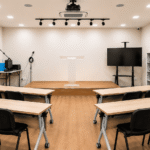
When selecting a space in Johor Bahru for STEM robotics and AI training, look for venues with flexible, well-lit rooms where equipment can be safely set up and tested. You’ll need reliable electrical supply and fast, stable internet connectivity—both are non-negotiable for this type of work. Climate control matters too; sensitive electronics perform better in temperature-regulated spaces. Storage for equipment between sessions and security for valuable kits are practical considerations organisers often overlook until it’s too late.
Beyond the basics, the venue should facilitate collaboration. Open layouts that allow easy movement between stations, tables suitable for robot assembly, and breakout areas for group discussions all contribute to effective learning. Staff support—helping with setup, troubleshooting technical issues, managing participant flow—reduces friction and lets instructors focus on teaching.
Permas Guru offers a professional, comfortable, and fully equipped venue in the heart of Johor Bahru, designed to accommodate diverse training and educational programmes. Located at 36-01, Jalan Permas 10, Bandar Baru Permas Jaya, the centre provides flexible rooms adaptable to your specific needs, whether you’re hosting a focused robotics workshop, a multi-day AI training course, or a hybrid seminar combining theory and hands-on exploration.
The venue’s facilities support the technical requirements of STEM robotics and AI work, offering reliable infrastructure and a professional environment that inspires confidence in participants. Whether you’re an educator introducing students to robotics for the first time, a corporate organisation upskilling employees, or an NGO delivering community technology education, Permas Guru can accommodate your group size and learning format with flexible booking options.
To discuss your STEM robotics and AI training plans and explore how Permas Guru can support your programme, contact the team directly at +6011-5354 9903 or email sales@smartouch.com.my. They can walk you through room options, technical capabilities, and logistics to ensure your venue is perfectly suited to your educational goals.
Conclusion
STEM robotics and AI education represents one of the most powerful ways to engage young learners, build critical skills for the modern economy, and inspire the next generation of innovators. By combining hands-on experience with thoughtful pedagogy, you create learning that sticks, motivates, and genuinely prepares students for the challenges and opportunities ahead. The key is intentional planning: clear outcomes, appropriate tools, progressive curriculum, supportive facilitation, and a physical environment conducive to exploration and collaboration.
As you move forward with developing or hosting your own STEM robotics and AI programme in Johor Bahru, remember that environment matters. The right venue removes barriers, supports your instructors, and makes every session feel professional and purposeful. Permas Guru provides that foundation, allowing you to focus entirely on delivering transformative learning experiences.
Ready to launch your STEM robotics and AI initiative? Start by clarifying your goals, then reach out to Permas Guru to explore how their flexible, fully equipped facilities can bring your vision to reality. Your next training session, workshop, or course is just a phone call away.
Permas Guru
36-01, Jalan Permas 10, Bandar Baru Permas Jaya, 81750 Masai, Johor, Malaysia
+6011-5354 9903 | sales@smartouch.com.my
“`